I had the privilege of going to Costa Rica in early March 2023 and as a Naturopath, this magical country resonated with me. The country has rich, lava-fed soils and the Costa Rican ethos is very much embedded in the organic world. They are proud of their natural farming practices and their sustainability. Rainforests and Cloud forests which were once being destroyed, have been allowed to regrow. Wildlife is protected. Tourism is their business and they have pleasure, and rightly so, in demonstrating their pure way of life.
A COSTA RICAN FAMILY GARDEN:
As part of my trip, I visited a Costa Rican family who revelled in showing me their wonderful, large organic garden, alongside which, a meandering river flowed. The temperature is consistently warm and tropical year round in Costa Rica, averaging between 22 and 28 degrees C, with regular rainfall, and daily rainfall during the rainy season between May and November, so the climate is conducive to perfect growing conditions.
Their land was full of exotic fruits;- mangoes, star fruit, grapefruit, oranges, avocados, pineapples, water apples, cocoa bushes (covered in pods in different stages of ripening) and coffee bushes (laden with beans).

Coffee bean bush
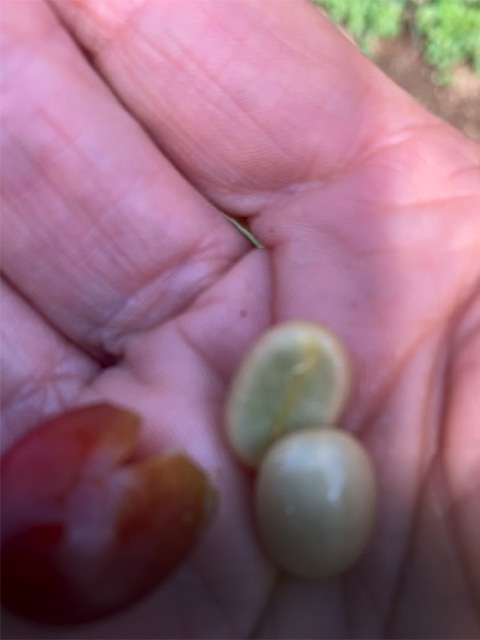
Raw coffee beans

Water apple & star fruit
They prepared a star fruit and water apple for me to sample. Both delicious.
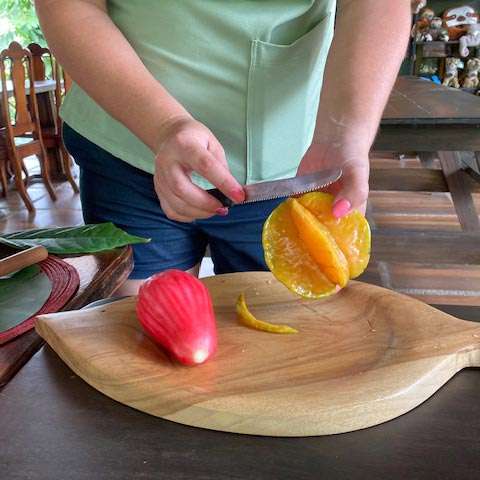
Preparing the fruit
Interestingly, the vegetable area had a great array of produce including all-year-round kale (this surprised me as this is something that grows well in a cold climate), but it seems to thrive there. The other particularly fascinating crop was the cassava root which just manifests as a stick in the ground.

Cassava stick
The starchy tuberous root is the source of food. Before using the root, it has to be properly detoxified by soaking, drying and scraping as it contains cyanogenic glycosides which could give cyanide poisoning! They described how they use it; they slice the root and use it to make chips as it has a similar texture to potato. It is also made into tapioca by peeling and grating the root to catch the milky fluid. The starch is then soaked in water for a few days, kneaded, strained to remove impurities, sifted and then dried. In the UK we mostly see it as tapioca flour.

Cassava root
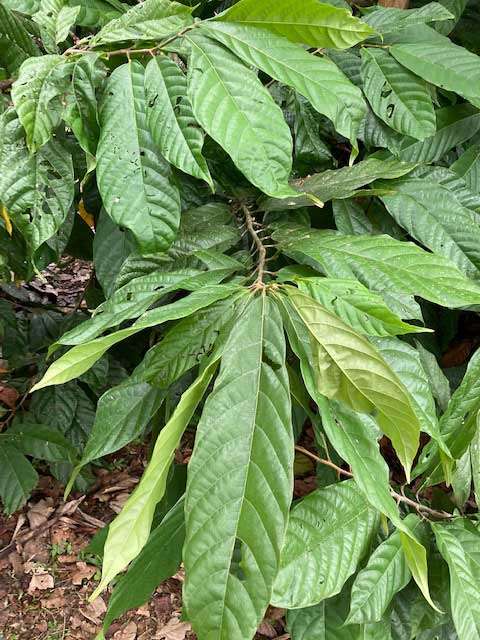
Cacao bean bush
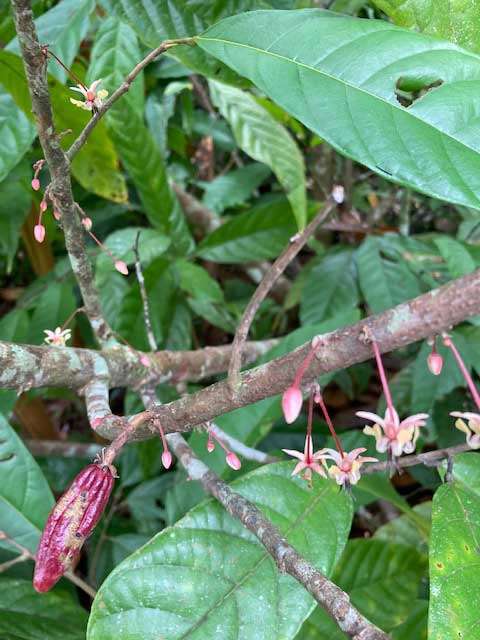
Cacao bean flowers
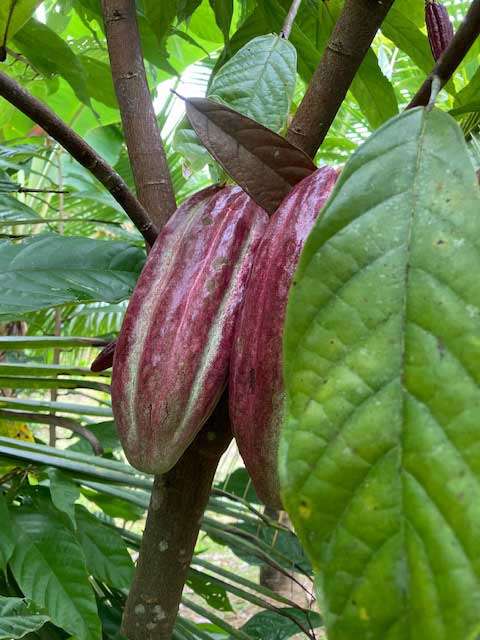
Cacao Bean pods developing
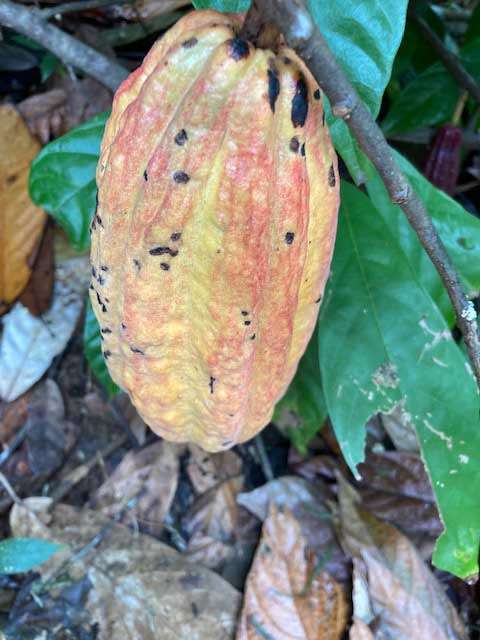
Cacao bean pods ripening
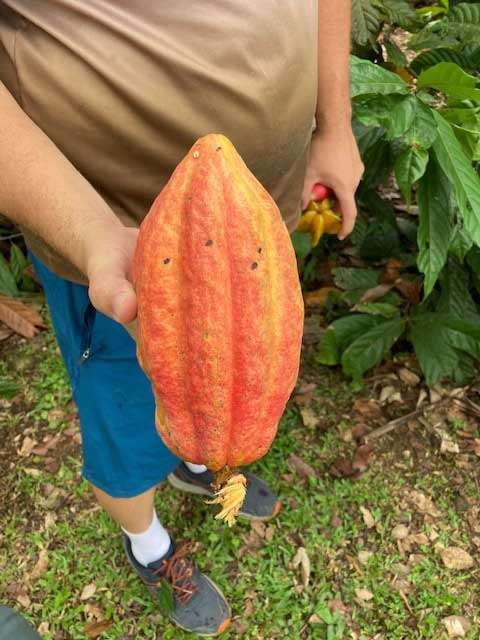
Cacao bean pod fully ripe
They then took me inside to demonstrate how real chocolate is made.
The ripe cocoa bean exterior is so hard that the only way to open it is to smash it with a stone. Inside are the beans covered in a white membrane.
These are removed from the pod and wrapped in a banana palm leaf for a week to ferment. They are then dried in the sun for a further week. Once dry, the beans are roasted for 15 minutes at high temperature. They come out of the oven with a crunchy shell which is smashed and the cocoa nibs inside removed.
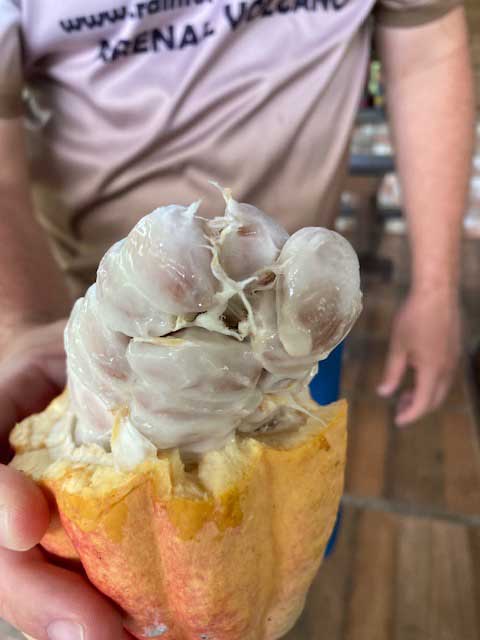
Inside the cacao pod
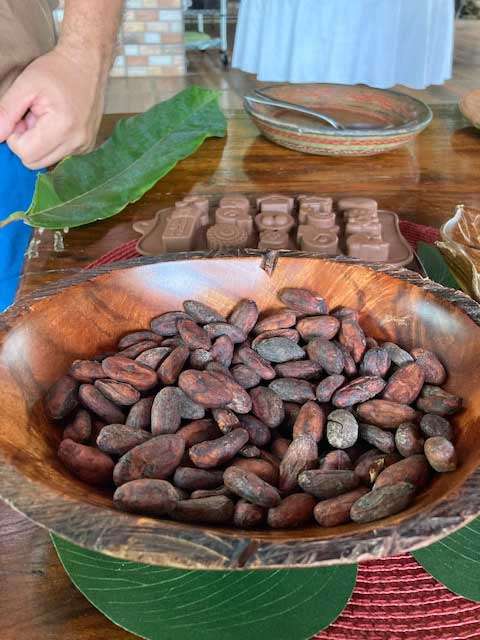
Roasted cacao beans
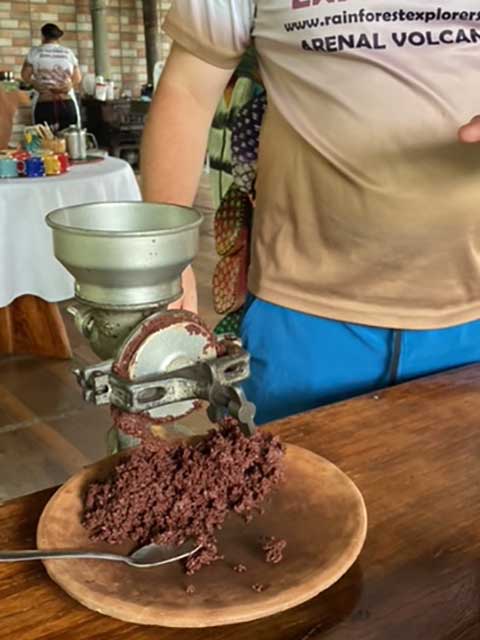
Cacao bean paste
These are put through a grinding machine and emerge as a paste because whole bean is used containing the cacao and the butter.
Sugar and vanilla to taste are then added to the paste and the mixture pressed into moulds. This creates a dark chocolate (If milk chocolate is desired, then milk powder can be added to taste).
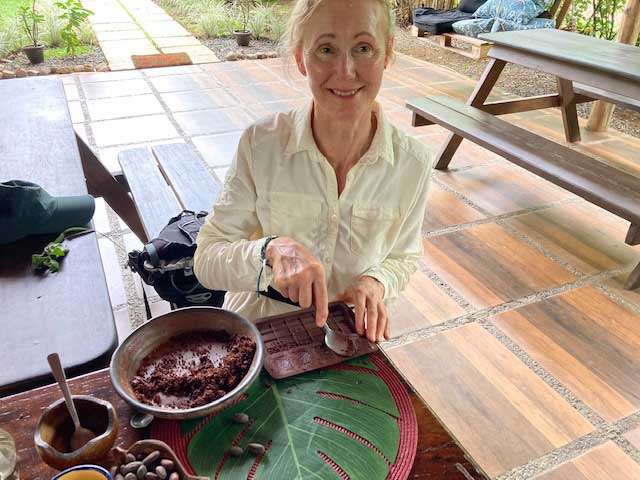
Fiona pressing paste into moulds
Next it is refrigerated for half an hour and subsequently turned out of the moulds.
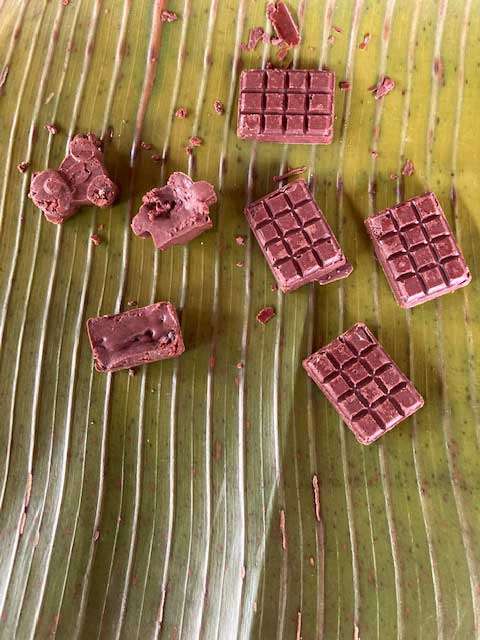
Chocolate bars!
I was encouraged to eat them! They were exquisite and very dark, so just to my taste.